The Theme
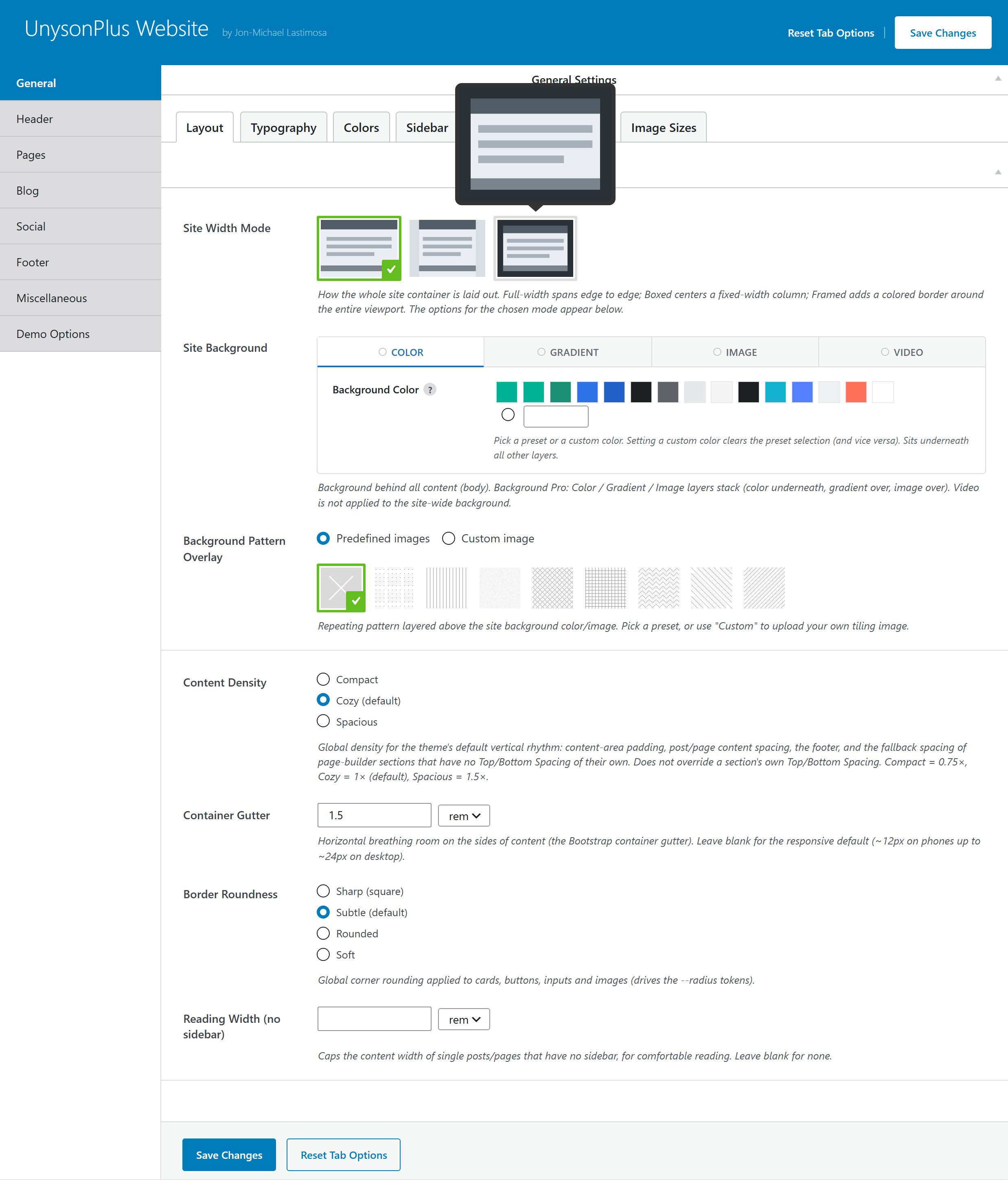
The Unyson+ Theme is the Bootstrap-5 parent theme built for the framework. It's where the plugin's page-builder output actually becomes a rendered site: the theme provides the header and footer chrome, the blog/archive templates, the base typography and grid, and the Theme Settings panel that controls the whole global design layer.
You rarely ship the parent theme directly — you ship a child theme of it (the way payforituk
is a child of unysonplus-theme). The parent gives you everything; the child overrides only the
brand and the few templates a specific site needs.
What the theme provides
| Layer | What it does |
|---|---|
| Templates | header.php / footer.php, the page templates (page-full-width.php, page-sidebar-left.php, page-no-header.php, …), and the blog/archive/search/single templates. |
| Theme Settings | A global design panel (Appearance → Theme Settings): colors, typography, header, footer, layout, custom CSS. |
| Design → CSS pipeline | Compiles those settings into one generated stylesheet — no inline <style> soup on the front end. See How settings become CSS. |
| Identity sync | Two-way sync of the logo and site icon with WordPress core (Customize → Site Identity). |
| Design export/import | Move a whole design (colors/fonts/header/footer/CSS) between sites as a .json file. |
Parent / child relationship
unysonplus-theme  (PARENT — the framework theme)
   ├── style.css            Version: 2.2.22 · Theme id: "unysonplus"
   ├── header.php / footer.php / page-*.php …      ← all templates live here
   ├── inc/includes/*.php    settings → CSS, identity sync, blog loop, migrations
   └── framework-customizations/theme/options/*.php   ← the Theme Settings schema
        │
        ▼  is_child_theme()
your-child-theme  (CHILD — what you ship)
   ├── style.css            Template: unysonplus-theme
   ├── functions.php        enqueue parent style; brand tweaks
   └── (override only the templates / option files you need)
A child theme inherits everything from the parent and overrides only what it declares. That
includes the ability to override extension files and add Theme Settings — through the same
framework-customizations/ mechanism the parent uses (see
The extension system). How to build and
distribute one is covered in Child themes.
The theme's manifest
The theme carries a small framework manifest at
framework-customizations/theme/manifest.php:
$manifest['id'] = 'unysonplus';   // namespaces the Theme Settings wp_option
$manifest['supported_extensions'] = array(
    'page-builder' => array(),
    'shortcodes'   => array(),
    'portfolio'    => array(),
    'sidebars'     => array(),
    // …
);
The id is important: Theme Settings are stored under
fw_theme_settings_options:{id}, so the id namespaces a theme's settings (and a child theme
forces the parent's version/author headers — see
the manifest model).
In this section
- Theme Settings — the global design panel: its tabs, the
multi/box→grouplayout convention, and the storage + read/write API. - How settings become CSS — the single generated stylesheet, the design-token pipeline, and where bespoke CSS goes.
- Child themes — building, overriding and distributing a child theme, and moving a design between sites.