Theme Settings
Theme Settings (Appearance → Theme Settings) is the global design layer: colors, typography, the header and footer, layout, and custom CSS. Page content lives in the page builder; this panel is the site chrome and design tokens. Together, a theme-settings file + a set of builder templates make up a complete "design package" for a site.
The schema lives in framework-customizations/theme/options/, where settings.php aggregates the
tabs.
The tabs
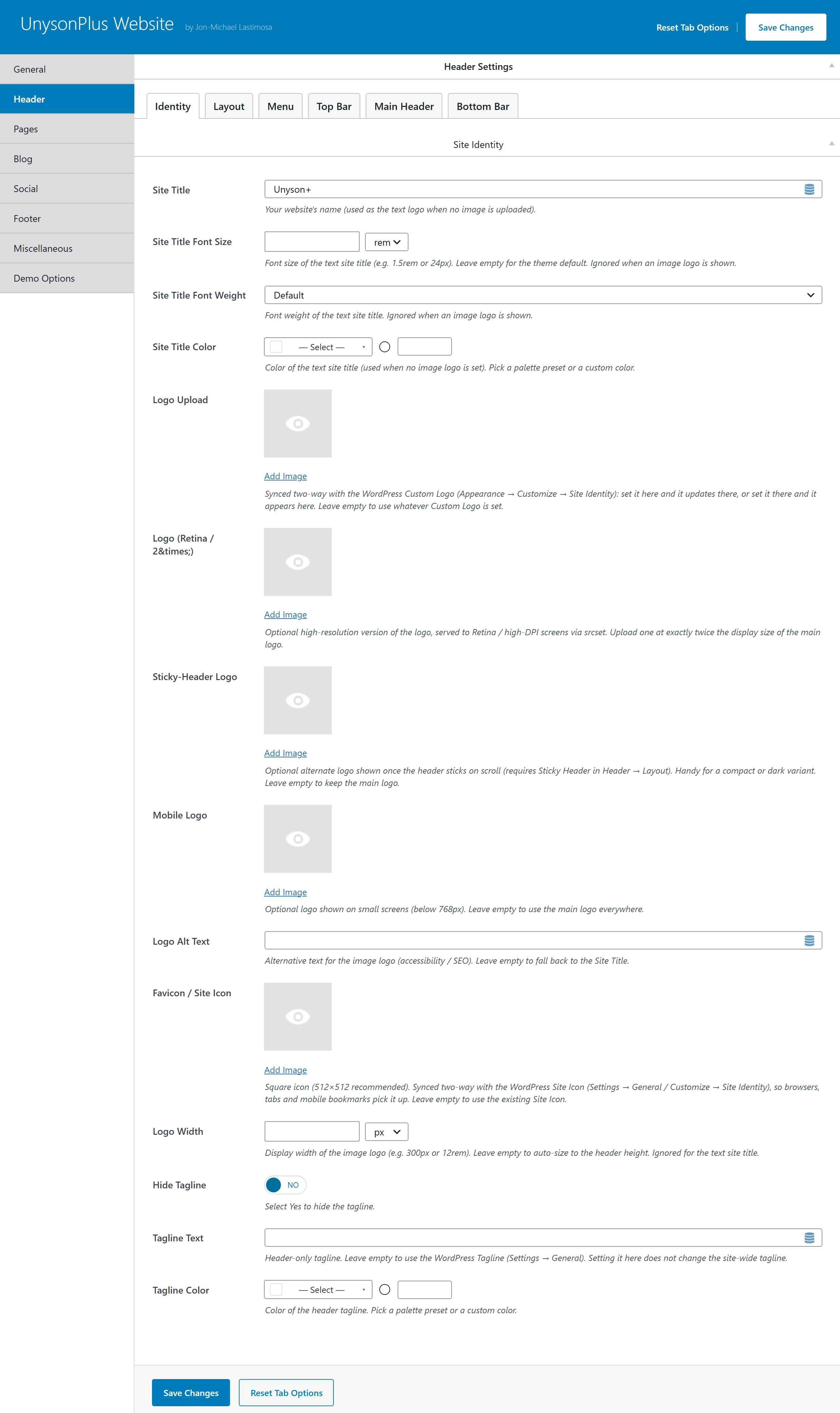
| Tab | What it controls |
|---|---|
| General | Sub-tabs: Layout (site width/background/spacing scale/border roundness), Typography (h1–h6 + body + custom fonts), Colors (pointer to the plugin's preset libraries), Sidebar, Preloader, Scrolling, Image Sizes. |
| Header | Sub-tabs: Identity (logo + favicon), Layout (header mode: top / vertical / off-canvas / overlay), Menu, Top Bar, Main Header, Bottom Bar. |
| Social | The social_profiles list (name, URL, icon, new-tab) — consumed by the Social Icons element and the footer. |
| Footer | Background/overlay, text & link colors, padding, and the Pre / Main / Post footer rows + copyright. |
| Blog | Index, Single Post, and Archives/Search layouts (list/grid/masonry, columns, meta, author box, related posts). |
| WooCommerce | A pointer tab (only when WooCommerce is active) — the real shop settings are owned by the WooCommerce extension. |
| Misc | Scroll-to-top, dark mode, global Custom CSS, custom scripts, analytics, performance, 404, maintenance, and the design Export/Import control. |
multi containerA tab or box is a multi container, so its top-level option id (general_layout, header_logo,
misc_custom_css, …) stores a nested array of that group's fields. Reads use the same key path
whether or not the option was later split across sub-tabs.
The box → group layout convention
This is the canonical look of Unyson settings pages, and the convention to follow for any
settings page built from option arrays. Each section is a box container — which Unyson
renders as a WordPress postbox (a bordered card with a title bar) inside a
.fw-backend-postboxes.metabox-holder wrapper. Inside each box, the fields are wrapped in a nested
group container, which renders a border-less <div> so the fields read as one cohesive group
(no inner borders between rows):
'general_layout_box' => [
    'title'   => __( 'Layout', 'unysonplus' ),
    'type'    => 'box',
    'options' => [
        'group_layout' => [
            'type'    => 'group',          // border-less wrapper — visual only
            'options' => [
                // the real fields live here; their ids (and saved values) are unchanged
                'site_width'  => [ 'label' => 'Site Width', 'type' => 'multi-picker', /* … */ ],
                'container_gutter' => [ 'label' => 'Container Gutter', 'type' => 'unit-input' ],
            ],
        ],
    ],
],
group wrapper is an id-only containergroup_layout is not stored — it's a layout container, so the leaf field ids (and therefore
saved values) are unchanged. Adding or removing the wrapper never loses data. Use a unique group
key per box (group_layout, group_identity, …) and apply it to every box for consistency.
This box → group pattern is the standard for settings/admin option pages. The one exception is a bespoke management dashboard with its own HTML/CSS/JS (the Shortcodes extension's card-grid settings page is the canonical example) — those are not wrapped in postboxes.
Storage & the read/write API
Everything on this panel persists to one wp_option, fw_theme_settings_options:{theme-id}
(the theme id comes from the manifest). Read and write it with the framework helpers:
// Read — null returns the full values array; multi-key paths drill in:
$layout = fw_get_db_settings_option();                          // everything
$bg     = fw_get_db_settings_option( 'general_layout/site_bg_color' );
$css    = fw_get_db_settings_option( 'misc_custom_css' );

// Write:
fw_set_db_settings_option( 'misc_custom_css', $value );

// Validate posted input against the schema (e.g. in a custom save path):
$values = fw_get_options_values_from_input( fw()->theme->get_settings_options(), $input );
Schema migrations
When you change the shape of stored settings (split an option, rename a key, drop a field),
don't rely on read-time fallbacks forever — add a migration. The theme runs them through one
versioned runner in inc/includes/migrations.php:
UNYSONPLUS_SCHEMA_VERSIONis the current target version.unysonplus_schema_migrations()mapsversion => callback.unysonplus_run_schema_migrations()(onadmin_init) runs every callback newer than the storedunysonplus_schema_version, in order, then advances it.
Each callback lives next to the code it migrates and must be idempotent — the version gate is
the fast path, the per-migration guards are the correctness backstop, so a re-run or a fresh
install is a no-op. To add one: write the idempotent callback, register <n> => 'callback', bump
the constant to <n>.
Reading Theme Settings inside an extension's _init() can force the option types to initialize
before the page-builder extension registers its page-builder option type, producing "Undefined
option type: page-builder". Defer settings reads to init or later — see
the boot guide.